

Living Systems Pathway
A pathway to becoming a living systems organisation
Every organisation has the potential to journey from a mechanical to a living system. The Living Systems Pathway maps this journey, showing how organisations move from survival‑focused functioning to thriving, adaptive ecosystems.
Across five stages, Seedling, Rooted, Growing, Flourishing, and Regenerative, the pathway helps leaders understand what healthy organisational growth looks like, what patterns hold them back, and what capacities enable renewal.
Combined with our survey, it offers a practical lens for understanding where your organisation is today and guiding its next step toward greater trust, adaptability, and collective intelligence.
When organisations grow as living systems, they do not just perform better; they become more human, resilient, and regenerative.
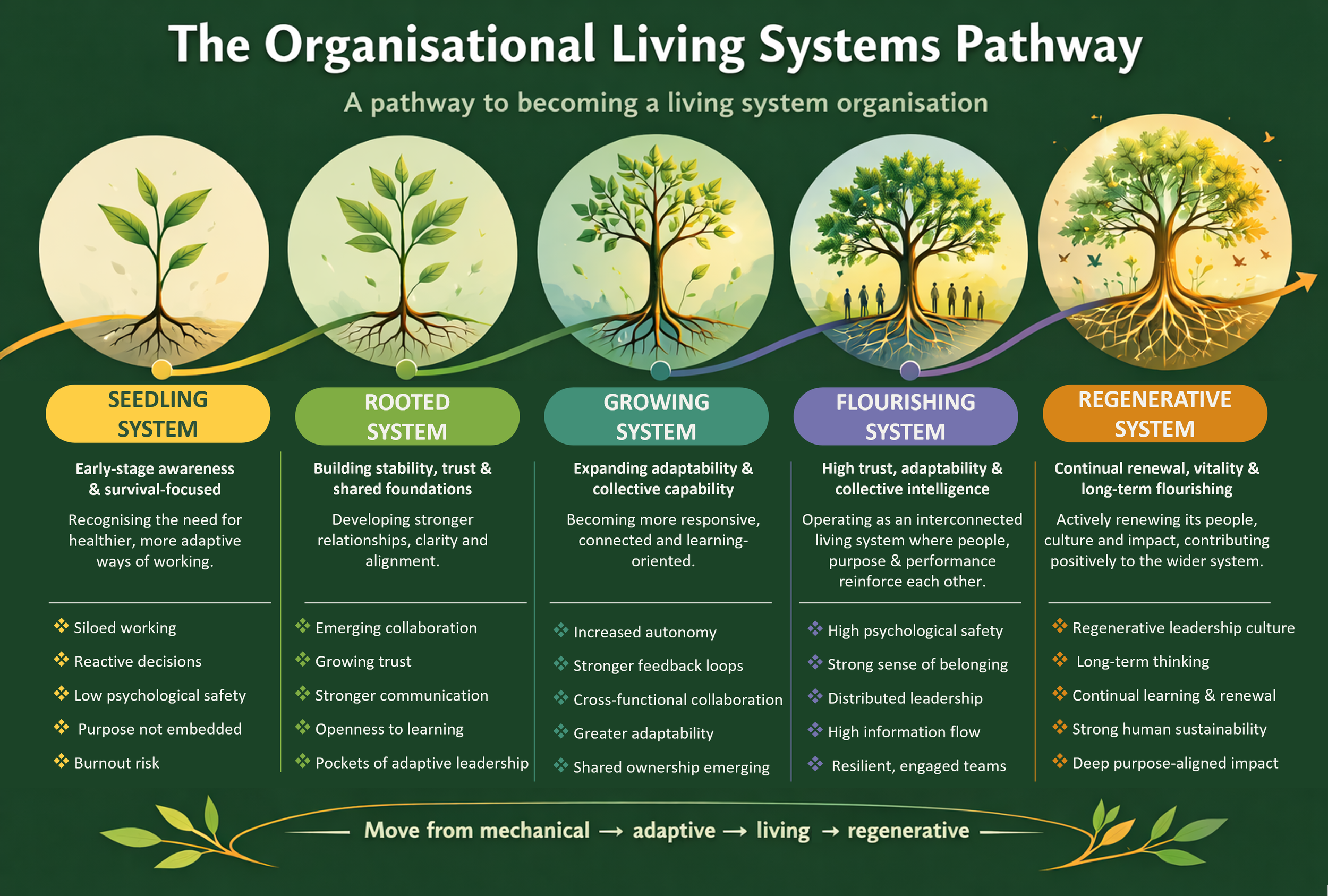
1. Seedling System
Early-stage awareness and survival-focused functioning
The organisation is beginning to recognise the need for healthier, more adaptive ways of working, but patterns of control, fragmentation, and short-term pressure still dominate.
Typical characteristics:
siloed working
reactive decision-making
burnout risk
low psychological safety
purpose not fully embedded
Primary need: Creating trust, clarity, and the conditions for healthy growth.
2. Rooted System
Building stability, trust, and shared foundations
The organisation is developing stronger relationships, clearer purpose, and greater alignment, though these qualities may still be inconsistent across teams.
Typical characteristics:
emerging collaboration
growing trust
stronger communication
increasing openness to learning
pockets of adaptive leadership
Primary need: Strengthening the cultural and relational foundations that support resilience.
3. Growing System
Expanding adaptability and collective capability
The organisation is becoming more responsive, connected, and learning-oriented. Leadership and decision-making are becoming more distributed.
Typical characteristics:
increased autonomy
stronger feedback loops
cross-functional collaboration
greater adaptability
shared ownership emerging
Primary need: Embedding adaptive behaviours consistently across the system.
4. Flourishing System
High trust, adaptability, and collective intelligence
The organisation operates as an interconnected living system where people, purpose, and performance reinforce one another.
Typical characteristics:
high psychological safety
strong sense of belonging
distributed leadership
healthy information flow
resilient and engaged teams
Primary need: Maintaining coherence while continuing to evolve and innovate.
5. Regenerative Ecosystem
Continual renewal, vitality, and long-term flourishing
The organisation actively renews its people, culture, leadership, and ways of working. It contributes positively to both human and wider system wellbeing.
Typical characteristics:
regenerative leadership culture
long-term thinking
continual learning and renewal
strong human sustainability
deep alignment between purpose, people, and impact
Primary need: Sharing learning, stewarding future growth, and contributing beyond the organisation itself.
Through our services, we support organisations to shift from mechanical thinking to living systems intelligence.
Contact Us
Get in touch if you would like to unlock your organisation’s living potential.