

Living Organisation Framework
How organisations become adaptive, human and alive
In a world defined by complexity and constant change, organisations that thrive behave less like machines and more like living systems. They succeed not through control but through connection, responsiveness and continual renewal.
Developed from the research literature, the Living Organisation Framework helps leaders see their organisation as an ecosystem; one that grows stronger through relationships, learning and shared purpose.
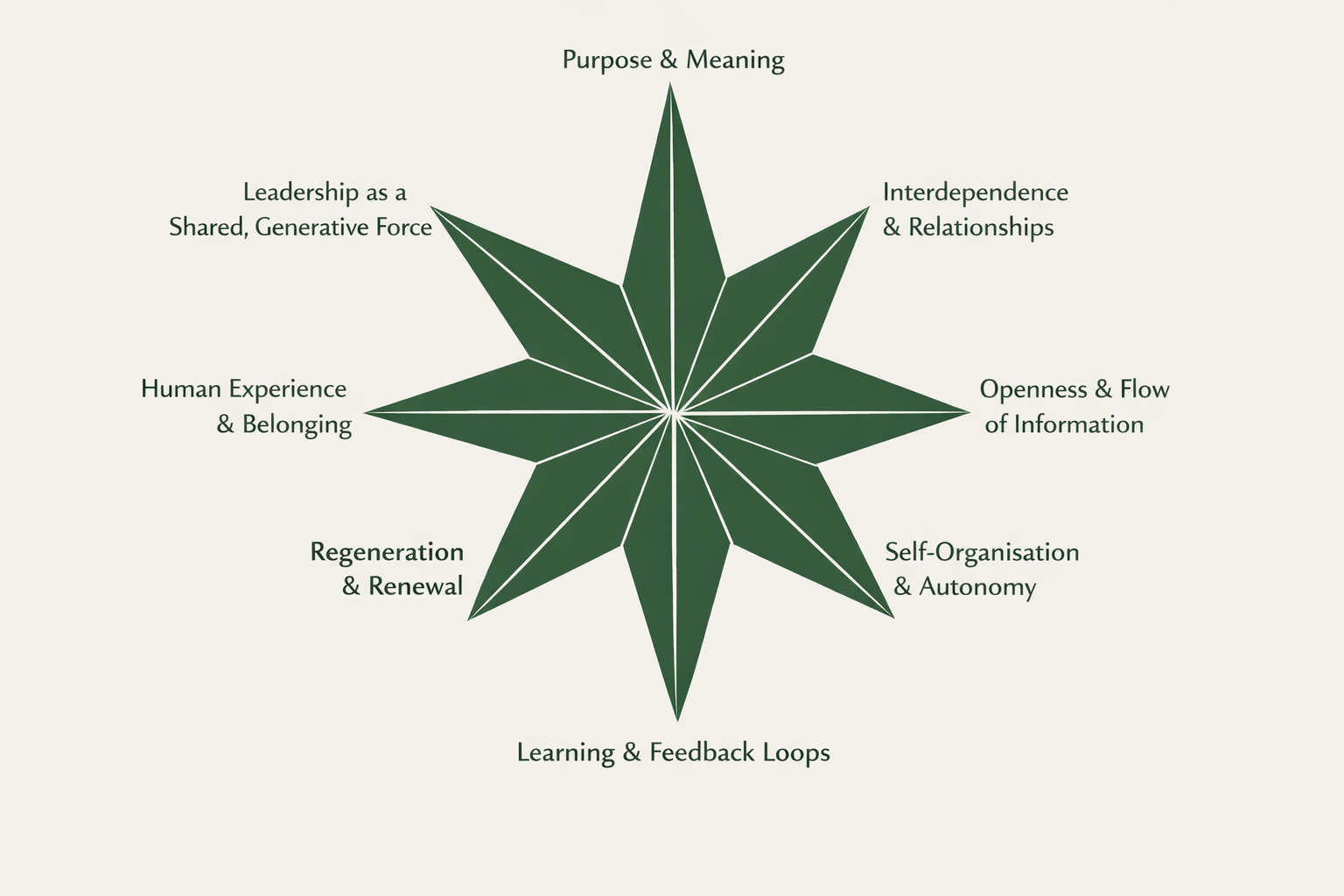
Eight domains
Purpose & Meaning: The orienting force that gives meaning, direction and coherence (Andrews, 2025; Robertson & Harder, 2021; Jansen et al., 2011)
Interdependence & Relationships: Teams understand how their work affects others; collaboration becomes natural (Robertson & Harder, 2021; Jansen et al., 2011; Mitleton-Kelly, 2003)
Openness & Flow: Information moves freely; people have the context they need to act with clarity (Robertson & Harder, 2021)
Self‑Organisation & Autonomy: Decisions are made where the knowledge lives; structures support adaptability (Robertson & Harder, 2021; Jansen et al., 2011; Mitleton-Kelly, 2003)
Learning & Feedback Loops: Reflection and experimentation are built into the rhythm of work; the organisation evolves continuously (Robertson & Harder, 2021; Jansen et al., 2011; Mitleton-Kelly, 2003)
Regeneration & Renewal: Work rhythms allow rest and creativity; energy and capability are replenished (Robertson & Harder, 2021; Wahl, 2016)
Human Experience & Belonging: People feel seen, valued and able to bring their whole selves to work (Robertson & Harder, 2021)
Shared Generative Leadership: Leadership is a collective capacity; authority is used to enable, not control (Andrews, 2025; Jansen et al., 2011)
Application
For leaders, the Living Organisation Framework offers a practical lens for culture change, leadership development and organisational design. It shifts the focus from managing people to cultivating conditions where people and purpose can thrive together. By nurturing openness, learning and belonging, leaders create organisations that are not only effective but alive; capable of sensing, adapting and regenerating in service of their purpose.
If you are interested in unlocking your organisation’s living potential, contact us. We would welcome a conversation.
References
Andrews, P. (2025). Reimagining organisations as living systems: beyond business as usual in A. Crockett, H. Hunter, and G. Johnsen (Eds), Environmental, Social, and Governance, in Sam De Silva, and others (eds), Expert Essentials (Oxford, online edn, Oxford Law Pro, 14 May 2025)
Capra, F., & Luisi, P. L. (2014). The systems view of life: A unifying vision. Cambridge University Press.
Jansen, C., Cammock, P., & Conner, L. (2011). Leadership for emergence: Exploring organisations through a living system lens. Leading and Managing, 17(1), 59-74.
Mitleton-Kelly, E. (2003). Ten principles of complexity and enabling infrastructures. Complex systems and evolutionary perspectives on organisations: The application of complexity theory to organisations, 1, 23-50.
Robertson, P. J., & Harder, J. W. (2021). Ecological organizing: Implications of evolving cultural values for organization and strategy in T. K Das (Ed), Cultural values in strategy and organization.
Wahl, D. C. (2016). Designing regenerative cultures. Triarchy Press.